You were away for two weeks.
The paper moved. Nobody can tell you how.
There is a new version, forty messages you half-read on your phone, and a section that has clearly been rewritten. Somebody decided something. You can see what changed. Nothing anywhere tells you why.
Revisenda is a live writing workspace for multi-author papers — you write together in real time, the way you're used to, and the reasoning stays attached to the manuscript, so coming back takes two minutes instead of an afternoon.
Collaborate live. Catch up anytime.
80 seconds, captioned — Catch Up, live co-writing, discussions that become decisions, and one-press compiles.
A real paper, start to finish
One NeurIPS 2026 paper, from submission to camera-ready
Our own accepted paper, Robust Diffusion Models via Divergence-Induced Weighted Denoising: its real manuscript and its real reviews (public on OpenReview), replayed step by step in Revisenda.
 Full size ↗
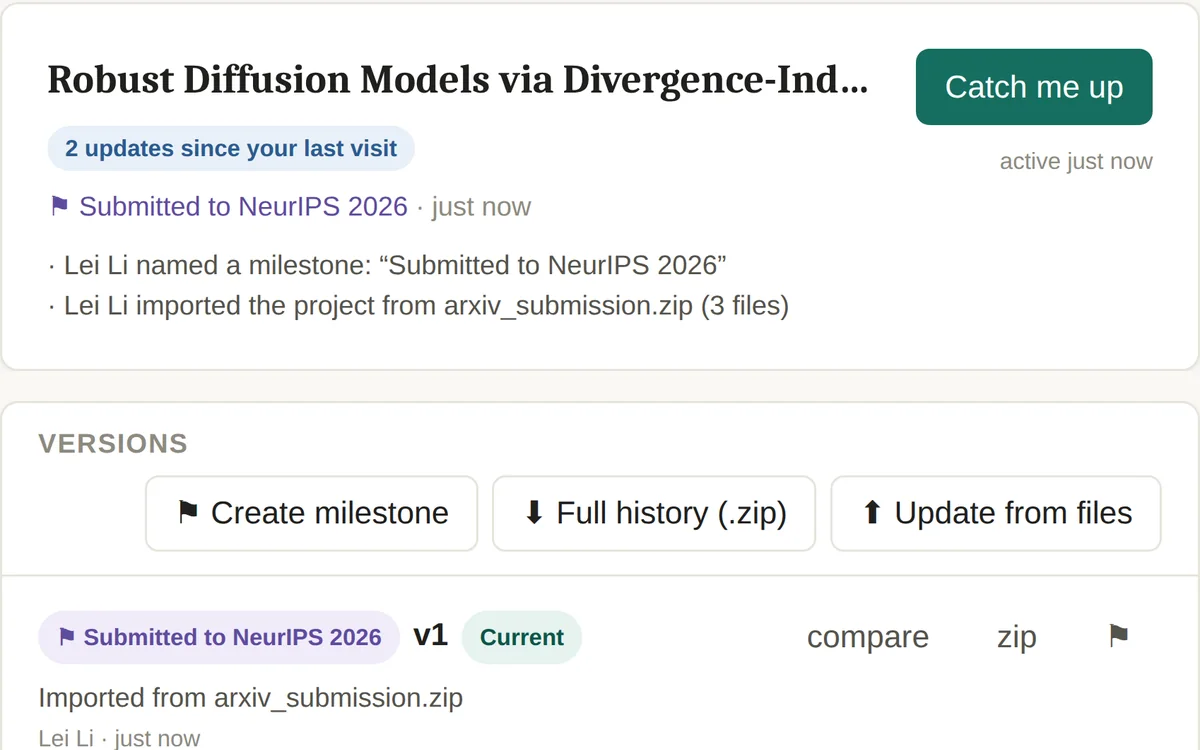
1 · Submission
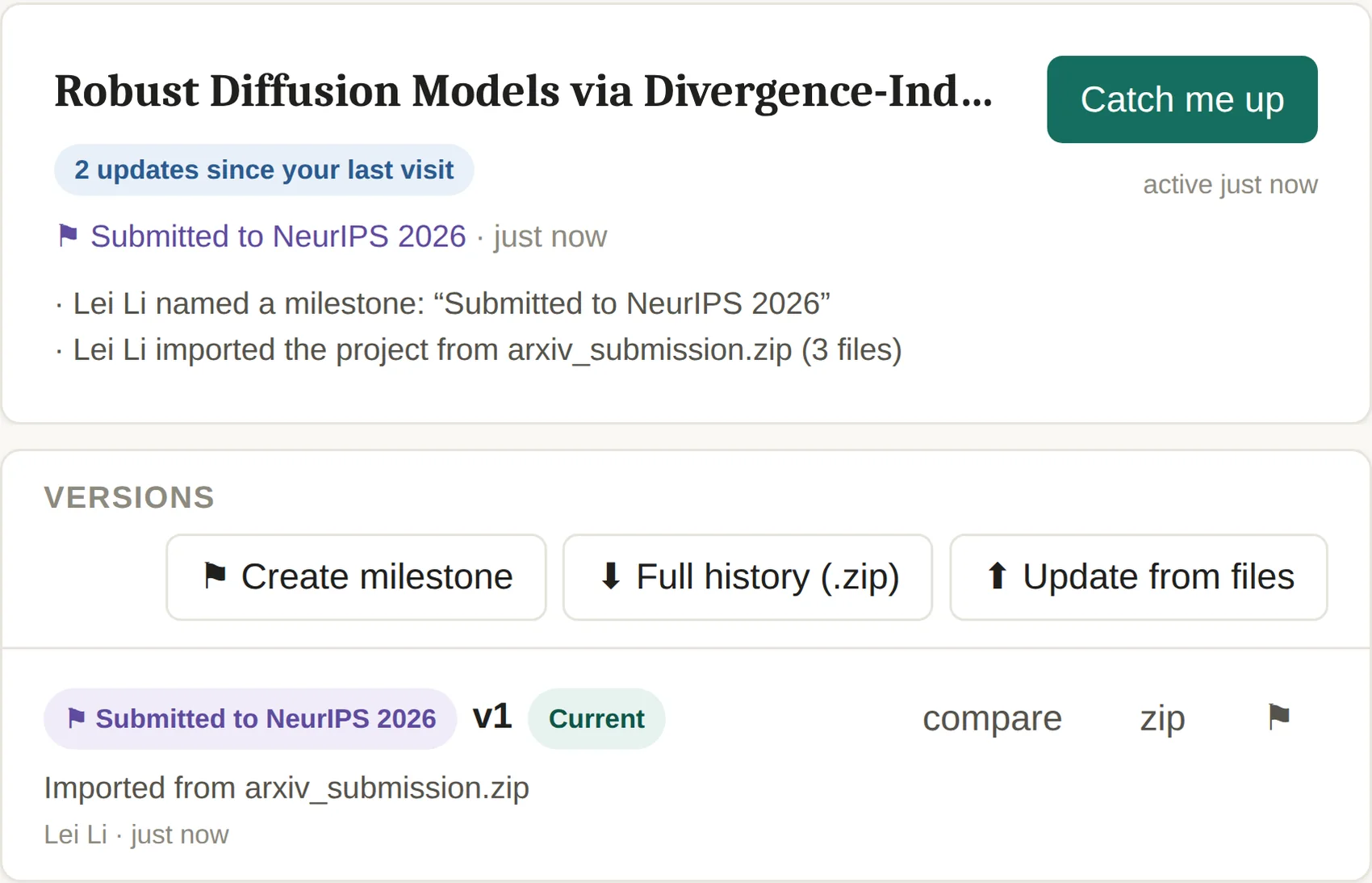
The version that went in, flagged
A ⚑ milestone marks the exact version submitted. It shows on Home and in History, so it's one click away months later.
 Full size ↗
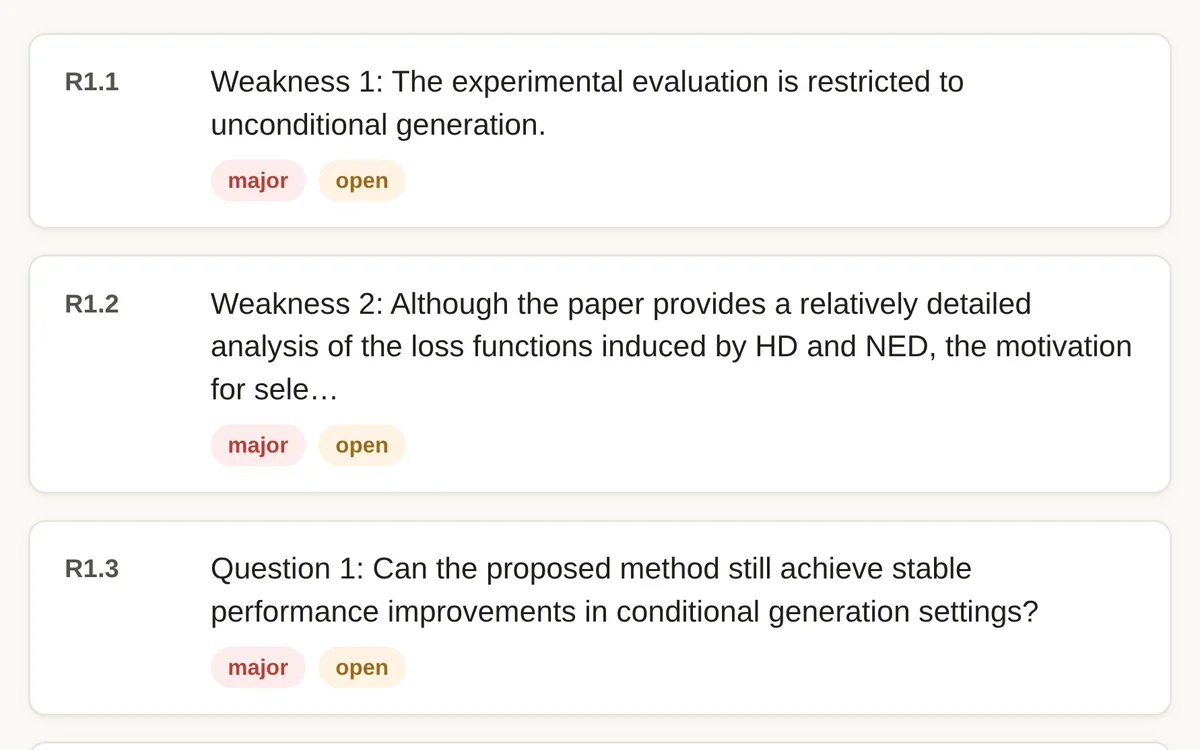
2 · Reviews
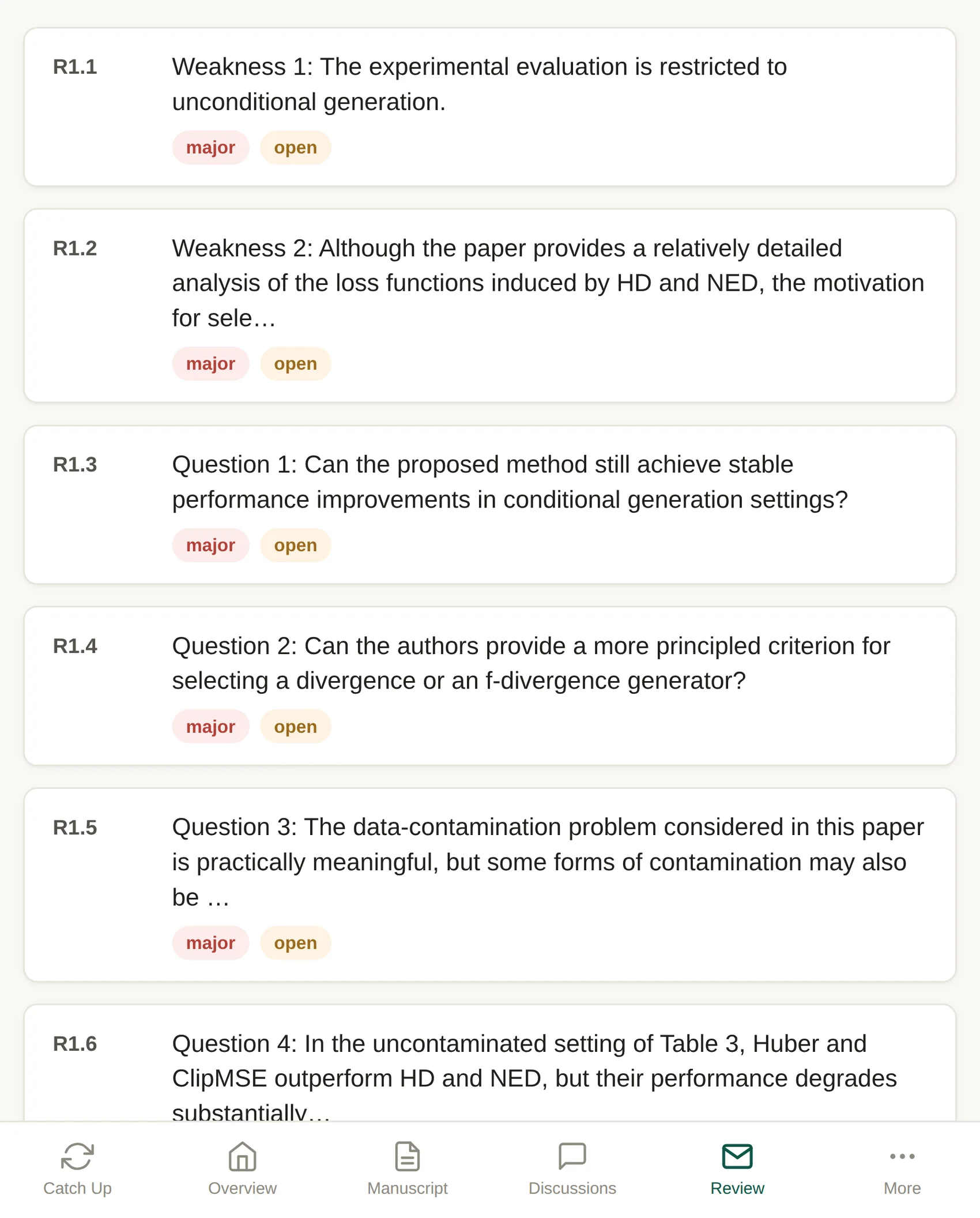
3 reviews, 19 points
Paste the reviews from OpenReview. Each weakness and question becomes its own item, tracked until it's resolved.
 Full size ↗
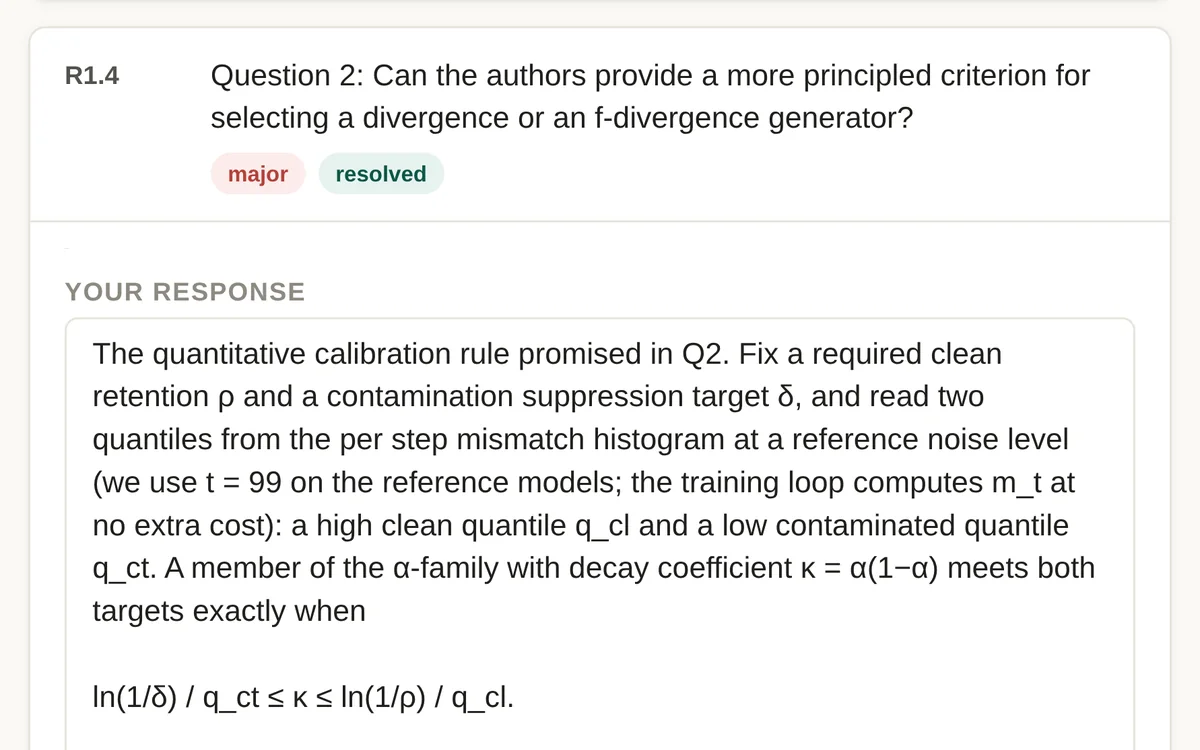
3 · Rebuttal
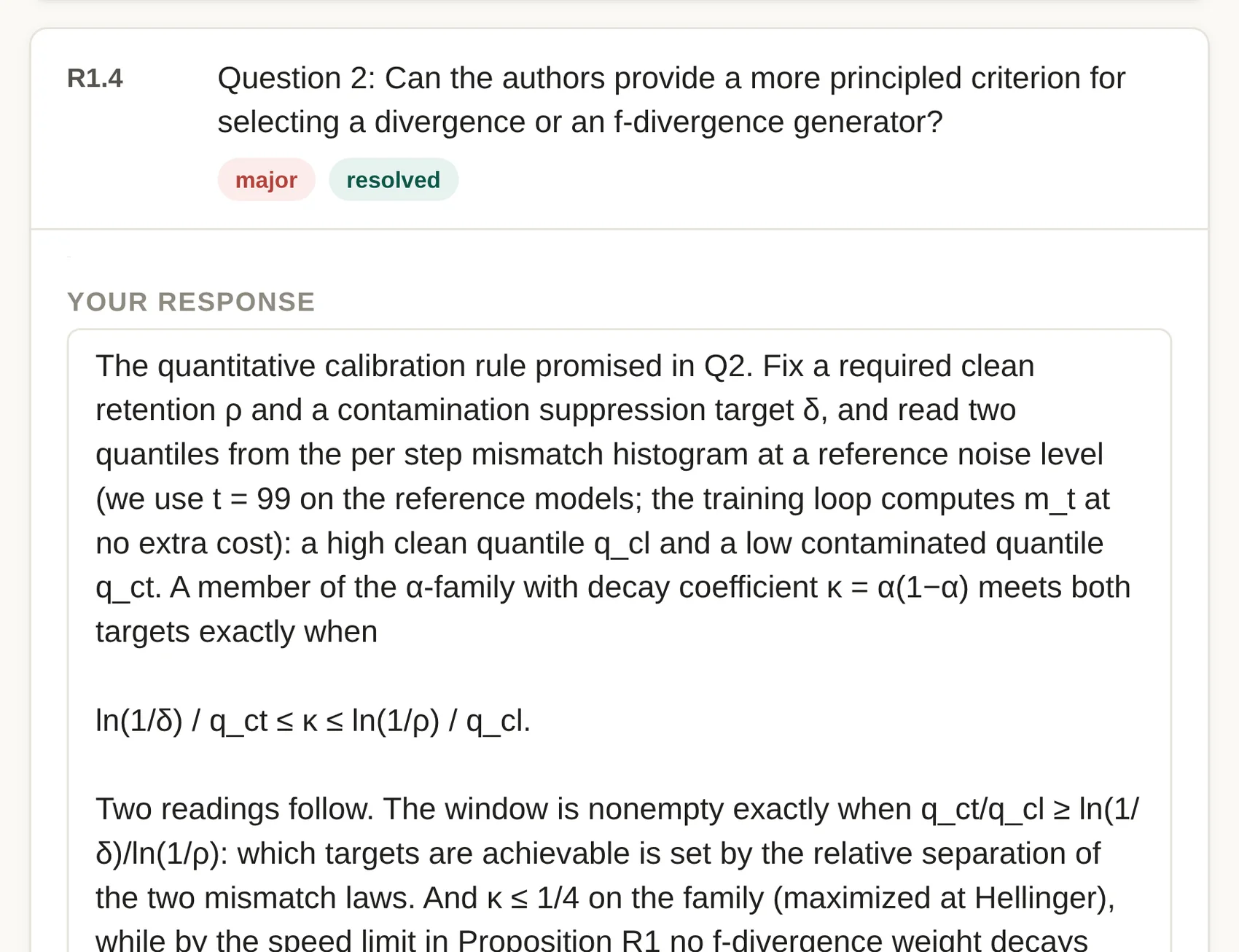
Every reply next to its point
Write each answer under the question it answers. One click assembles the rebuttal, and any point still unanswered says so.
 Full size ↗
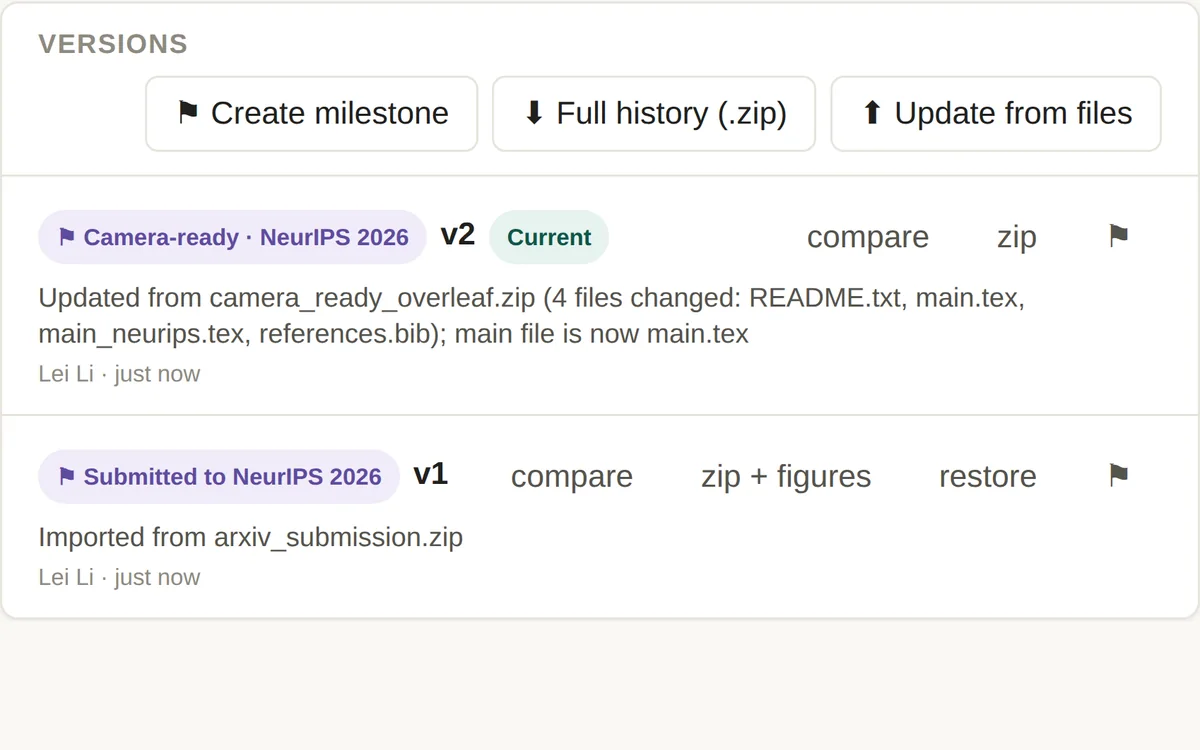
4 · Camera-ready
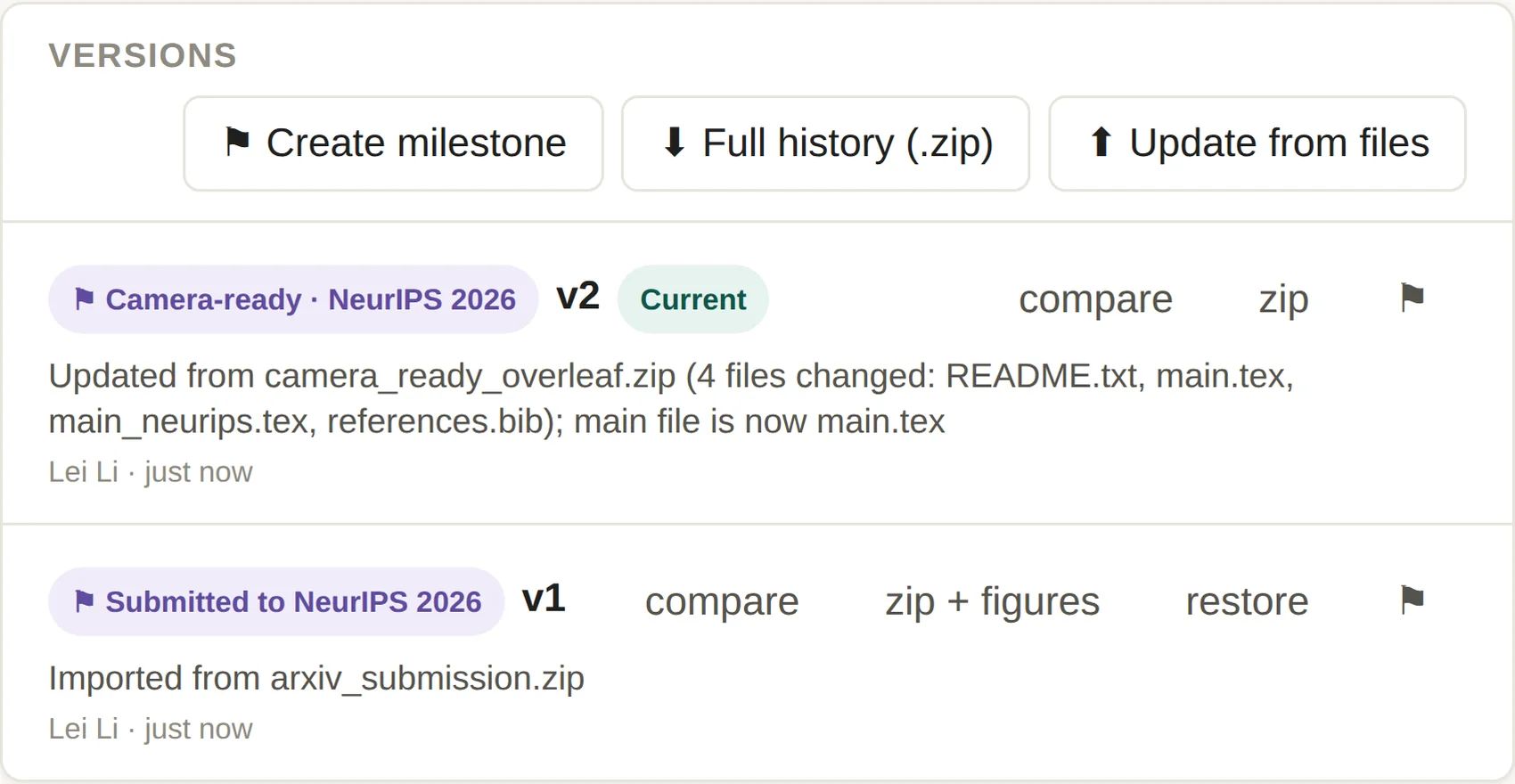
The camera-ready arrives as a zip
Drop the Overleaf zip: it becomes the new version, and the submission is kept beside it as a zip with its figures.
New here? Start with the ten-minute guide — or read how reviews and rebuttals work.
Catch Me Up
One button. What changed since you were last here, ordered by scientific importance, every claim traceable to the message or decision it came from. If it can't cite a source, it doesn't say it.
Decisions that stay decided
When an argument ends, the conclusion is recorded with its reasoning and attached to the manuscript. Six months later, when a reviewer asks why you assumed that, the answer is still there.
AI that proposes, never decides
Anything the AI wants to change arrives as a proposal with a diff and an explanation. Nothing it writes touches the manuscript without a human saying yes. Your co-authors, of course, just type.
The reviewer round, handled
Paste the decision letter, or a conference's reviews from OpenReview. Each comment becomes a tracked item you can assign, discuss and answer, and one click assembles the response letter — or the rebuttal — from your answers, with any unanswered point marked as pending.
Written in LaTeX, compiled here
A real editor with a PDF beside it, click-to-jump in both directions, and errors explained in words. Import an existing project as a zip or from Git.
Live together, whole apart
Same file, same moment: everyone sees everyone's cursor, and versions save themselves after quiet stretches. And when your co-authors are in four time zones, the project's memory covers the hours you're never online together.
Where this is up to
It works and it's in daily use, but it is early — the group using it is still small enough that when something breaks, it gets fixed the same day. Try it on one paper: a new draft, or the revision you're about to start.
It's free while it's early — here's what it will cost when it isn't, so you can budget (short version: the owner pays, everyone invited is free forever, and you get 30 days' notice before billing starts). Your manuscripts are yours: you can export everything as a zip at any time, and delete your account and its data from inside the app. Who can see your work explains exactly where things are stored and who can read them.
Built by a statistician who got tired of reconstructing why a paper says what it says. If you've lost an afternoon to the same thing, we probably agree about the problem.